First, a few words of welcome ...
Choosing who you'll work with is one of your most important strategic decisions.
You may already have a sense of your answer to this question. Still, it's so important that it's worth putting a bit of discipline to it.
At the same time, your decision now is not cast in stone. This is a question you're likely to revisit often and the answer is likely to change over time. You may also decide to work with more than one "who," as we do.
So we encourage you to give this some good attention and to hold your initial decision lightly. We want to see you move through this quickly and move on to sketch out the concept for your first offering.
Learning the process -- how to think about this question -- may be even more important than the outcome at this point.
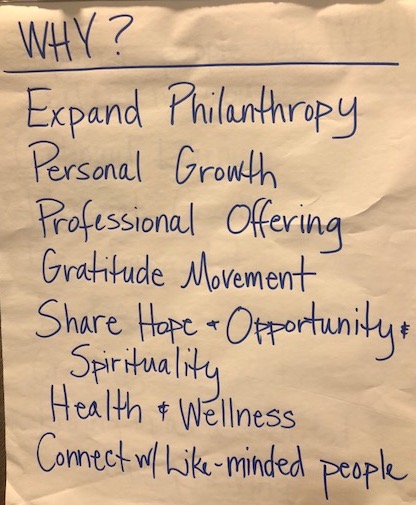
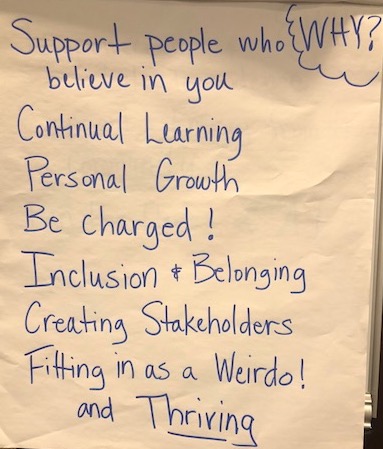
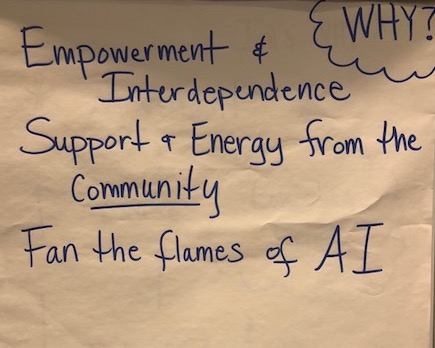
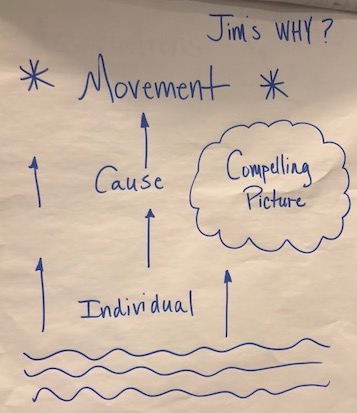
To get you started, here are the "why?" and "who?" flip charts we worked with in Cleveland.
Why?
Who?
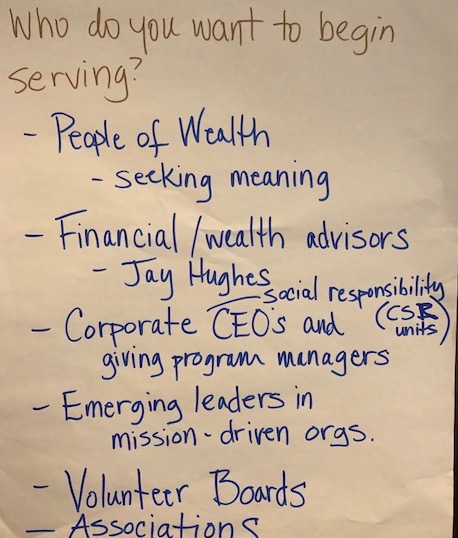
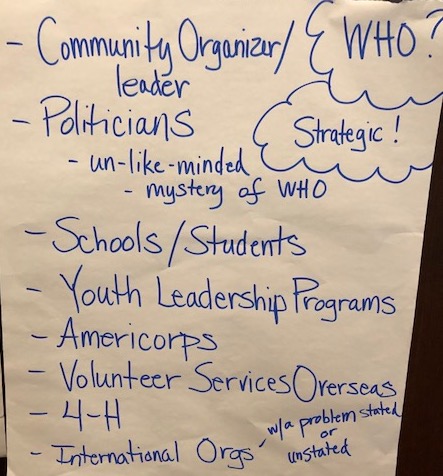
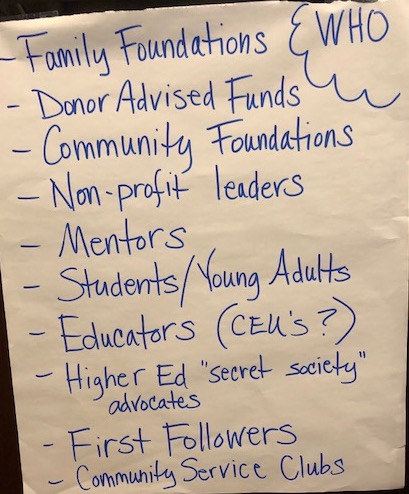
Niche Clarity Worksheet
This worksheet is optional, but strongly recommended. It's one of the most valuable tools we use with consultants as they develop their practices — because the "who" is so crucially important to all aspects of success.
First: Take from your Summary, your answer to "What kind of world do you want?" And the contribution you want to make, as you envisioned in your Compelling Picture.
Now with that in front of you, ask yourself:
- What kind of people do you want to work with? For example, what are their roles?
- What kind of systems (organizations or communities, for example) do you want to work with?
Brainstorm your ideas on a big sheet of paper. (We like to say, big paper for big thinking.) You'll likely end up with many possibilities in front of you. Maybe too many for your lifetime? Surely too many to handle all at once.
So where to begin?
One way to choose where to start is to work through the "Niche Clarity Worksheet." You can download the worksheet below to get into it. But first, a few words of guidance.
How to use the worksheet: Put each possible "who" you've identified at the top of a column. (This isn't names of people, it's categories of people and/or kinds of organizations. For example, universities or CEOs of environmental organizations.) Then rate each of them on the various criteria. You can use a numerical rating, or just a checkmark. What's important is that you give each item serious thought. You may be surprised by what you discover.
You may also be surprised to see this worksheet is more about problems than possibilities. That’s because to get the attention of most people, a problem is more compelling as a place to start. And most folks are more willing to invest in solving a problem than in pursuing a possibility.
Once you have their attention, you can begin to reframe the problem. And then look for strengths so you can shift into the higher aspirations.
What's meant by the reference to a "hungry crowd"? There's a story about two people who each decided to set up a hot dog stand.
One spent a lot of time and money to get the fanciest sign for his cart. He made sure he had the very best quality hot dogs and buns, with every topping he could imagine. Then he set up his cart and waited patiently for customers to find him ... and waited ... and waited ...
The other did a "good enough" job of setting up her cart. Then she looked around to find a crowd of hungry people — and simply rolled her cart over to serve them. Whoosh!
The moral of the story? You can make everything much easier on yourself if you take the time to ask: Who's already hungry for what I have to offer? (We already know you'll pay plenty of attention to the quality of what you do, but the "hungry crowd" question is too often ignored.)
Criteria for selecting clients
Once you've chosen your (possibly tentative) “who” group, we recommend you develop criteria you'll use to select the particular individuals you'll engage with first.
These criteria are based on characteristics you want to see in the individuals you work with. (Characteristics meaning personal qualities, as when we had dinner after the interviews and described what struck us about each other.)
You can then use the criteria to answer the question: "Is this person likely to be a good fit for me as a participant, and are we likely to be right for each other?"
A simple step-by-step process you can use
To make this easier, you can develop your criteria by adapting or adopting our template. In a moment, you'll see the set of criteria we used when you were invited to your first retreat, and then into the certification program. But first ...
1. Think about the key characteristic you might hope to see in the folks you’d like to work with. You could think about someone who you met during our time together. What struck you about them? Write it down.
2. Once you have one or more characteristics, set it aside. And set aside for a moment your thoughts about others who you may invite.
3. Now look at the criteria in this document.
And try this: Stand in our shoes while reviewing the characteristics listed. Now you know what we see in you! Really, it’s worth a good pause and a couple of deep breaths.
4. After you take in how these characteristics attempt to describe you, it's time to develop your own criteria. You can use the document as just a thought-starter — or at the other extreme as a template to be adopted for your own criteria. (If you add any characteristics, try to delete an equal number. The fewest possible is our mantra.)
You’ll notice that we include “facilitator’s presence.” That is not a required characteristic, but we like do like to consider it. That's because we especially like to attract those who might, at some point, join the certification program. That could still be included in your criteria. It's up to you.
As an option, you can also include simple demographic criteria (gender, age, etc.) to add to these more "psychographic" characteristics.
If you’re going to invite someone to nominate candidates for your retreats, you could share your criteria with them.
We have also shared the criteria with the persons themselves under consideration, or after they’ve accepted an invitation, so they can know what we see in them. (This step is part of getting folks to own up to what makes them so cool.)
You might think that having a set of criteria will cause you to be pushing away some folks.
The way we use our criteria, they are intended to attract and lift up a particular kind of person. (Someone like you.) And to push us away from others.
But we’ve actually found that people will often think of more candidates when they are at the stage of reviewing the characteristics, and brainstorming possibilities — because a characteristic brings someone to mind.
Would you like more support on this?
You might want to schedule one of your calls to talk this through. We are here for you at every step along the way. Or email us a question and we'll answer it so the whole group will benefit.